For one week each year, Black Rock City transforms the Black Rock Desert into one of the world’s greatest contemporary art playgrounds. A place where big, ambitious artistic ideas from around the globe find support and take shape in one of the most challenging environments on the planet.
But remember, art does not magically spring forth fully formed from the dust. These projects are the visible expression of immense teamwork and time gathered from all corners of the world. Each piece represents months of shared labor, stress, and resources, wired together by connection and creativity. This year is no exception.
Soon, the playa will fill with magic from many cultures, including a Romanian dragon assembled from the desert’s discarded branches, an interactive sculpture that allows strangers to move together without speaking, and a Colombian meditation on ancestral knowledge and sound. The materials and cultural influences may differ, but at the heart of each project are similar lessons in collaboration and community. Make no mistake, Burning Man art requires many hands.
These projects are just three of 72 funded Honoraria artworks that will rise this year as part of Axis Mundi. In 2026, Burning Man Project invested more than $6 million in bringing art and artists through grant funding and extensive equipment and logistical support. Of this, more than $1.5 million was granted to artists through the Black Rock City Honoraria and Temple programs. These investments often inspire well beyond the dust, with many Honoraria-funded artworks eventually finding homes in cities and parks around the world.
It’s not too late to bring your work of art to Black Rock City Axis Mundi. If your art is 10 feet high or smaller, does not have pyrotechnics, and won’t be burned, you can register it as a walk-in at the ARTery.
Finding the Exact People We Needed
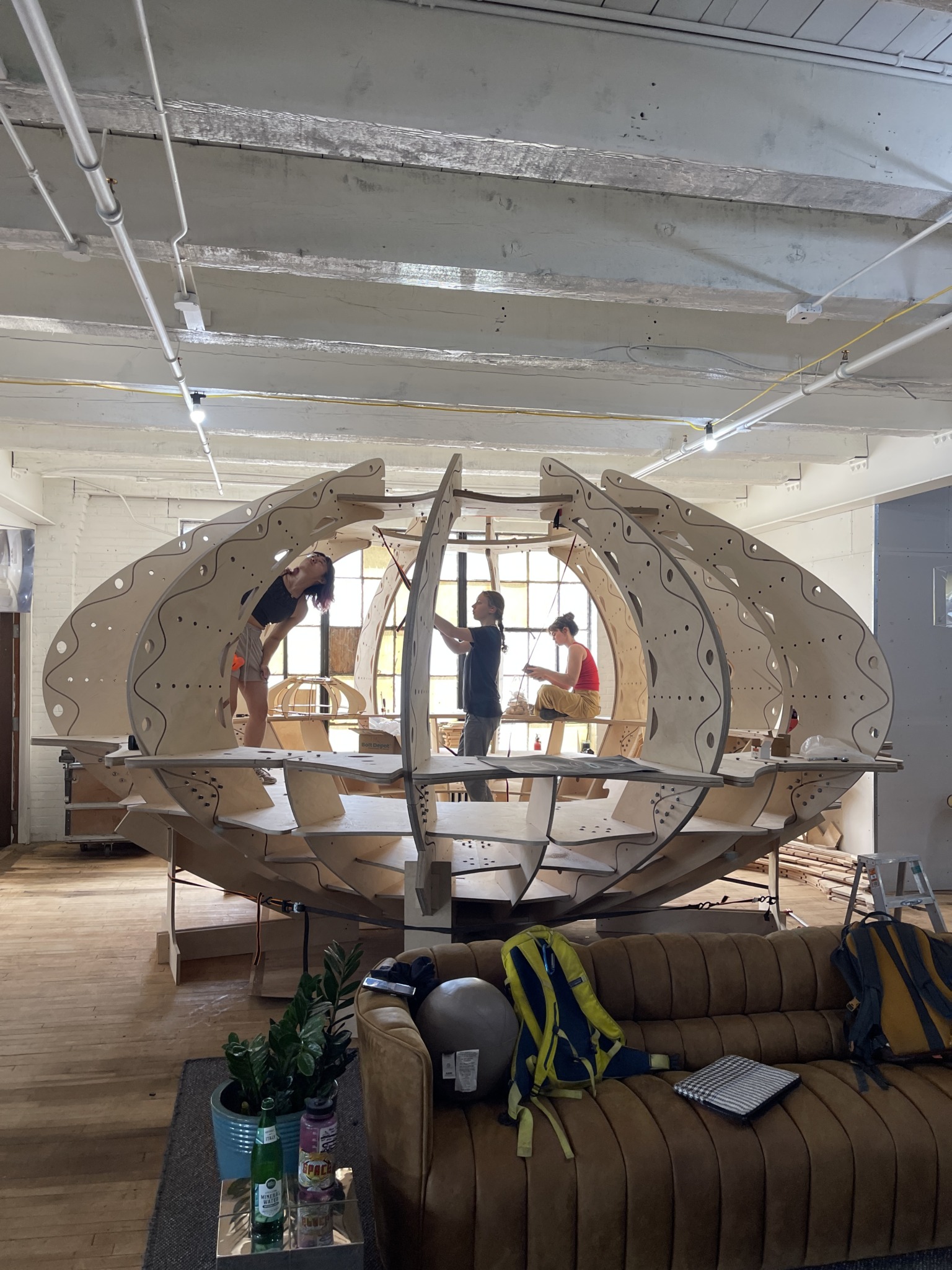
Ready to play? Artist Linda Qian’s “Harmonic Orbiter” resembles a giant tilting carnival ride that asks participants to collaborate in an unspoken dance. Dozens of strangers may find themselves synchronizing their movements as they balance one another in a spinning, tilting harmony.
“It’s a hybrid between a topple toy and a tilted chair you spin around on,” Quian says of the one-ton, 16-foot diameter, LED-lit structure. “It’s a really simple way for people to tune into each other, to get into the same frequency of movement.”
Qian, who is originally from Toronto but is building the Orbiter outside Boston, where she studies architecture at MIT, has been to Black Rock City once before, in 2023, on invitation from Burning Man Project after her initial Honoraria proposal was not selected. Now, Qian is returning to the dust with her “Harmonic Orbiter,” her first on-playa art project, thanks to an Honoraria grant and many willing collaborators.
“I was so inspired at Burning Man that I wanted to give back,” Qian says.
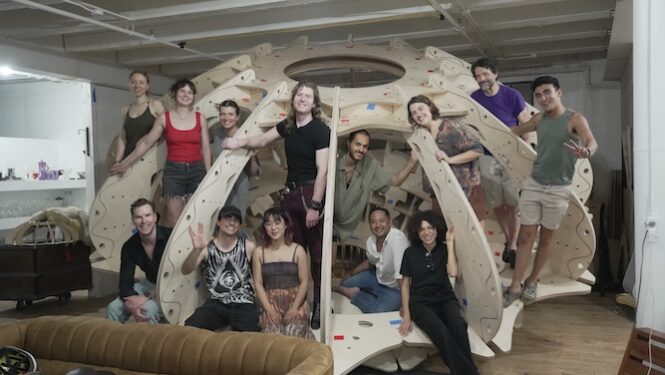
Remarkably, the twenty-person team helping her build the Orbiter (which the crew lovingly call “Orbi”) consists almost entirely of Burning Man newcomers.
“It’s people who are stoked to work on a volunteer-driven passion project,” Qian says.
The learning curve, however, continually proved enormous. Designing a 2,000-pound structure capable of holding up under the chaotic demands of Black Rock City participants required months of calculations and prototyping. Qian consulted professors at MIT and friends at Harvard to model the structure and make sure it was up to the task.
”I consulted a lot of technical people,” she says. “It was insane, trying to predict the movements.”
But every obstacle, she says, has been met with support.
“We’ve found all of the exact people that we needed,” she adds. “We got to meet the Burning Man community in Boston, and things have been kind of falling in our lap.”
Volunteer Anya Zak is one of the people piecing the Orbiter together. Having never been to Black Rock City before, the 23-year-old who grew up in Russia is excited to see how the team’s work and Qian’s vision finally settles into the dust.
“What excites me is the unknown,” Zak says. “It’s very different having the orbiter in this warehouse versus it being on playa in the middle of the desert, so I’m excited to see people get creative.”
Thrown into the project without knowing many people on the team, Zak says she’s discovered connection through the work of building Orbi.
“We started working very quickly not knowing much about each other, and now we’re making friends through this intense project,” she says.
What Are You Dreaming of Building? Here I Am, Let Me Help You.
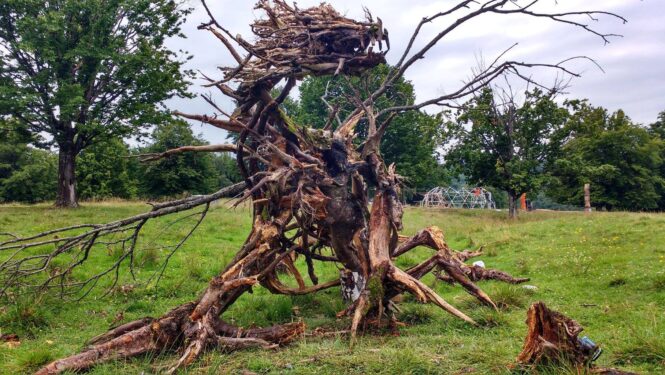
Meeting the right people is how Romanian artist Andrei Ciricǎ’s path to Black Rock City finally took shape this year. Ciricǎ is a land artist who repurposes found natural materials into huge dragon sculptures. This summer, he’s traveling from his home in Transylvania to spend a month at Fly Ranch, Burning Man Project’s rural center in Northern Nevada, collecting branches and other natural materials, which he will then form into a 40-foot sculpture he calls the “Elemental Dragon.” Ahead of the event, his dragon will be dismantled, transported to playa, and assembled again, before eventually returning to Fly Ranch, where it will live indefinitely. Each dragon can require upwards of 1,000 pieces of wood and thousands of screws, he says.
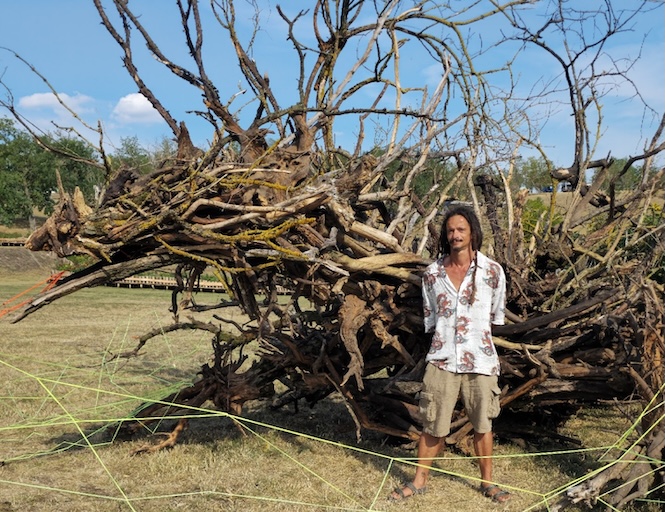
“It’s a very primitive thing what I do,” he adds. “I just use the shapes that I find in nature, and take only what nature leaves for me.”
This year will be Ciricǎ’s first time in Black Rock City. And while he calls his adventure an “exercise in madness,” he’s excited.
“I’ve been hearing about Burning Man for a very long time,” he says. “I always wanted to go there.” But, he adds, life in Romania had not allowed him the financial ability to travel to Black Rock City. Until now.
His path to playa is also being helped by many hands. An Honoraria grant plus some friends with strong Burning Man connections means Ciricǎ and a small crew, will be able to make the trip, and also have a camp to call home.
Much support came from event designer and longtime burner Diana Velica, who connected Ciricǎ to broader Burning Man communities.
“I see their magic,” Velica says of Ciricǎ’s dragons. Velica, who lives in Burachrest, is continuing to support the project’s journey to playa.
Velica herself has been bringing her gifts to Burning Man since 2018. She built castles in her camp in 2022, which she says expanded her view of what’s possible. She sees these acts of collaboration as helping remove obstacles between artists and possibility.
“By contributing to someone’s art project, you are contributing to really changing someone’s destiny,” she says. Plus, she loves Ciricǎ’s dragons, having invited him to build one for an event she threw at Dracula’s castle in Bran, Romania.
“I think of [Ciricǎ] as an elf or something, someone who communicates with nature and finds these beings and brings them to life,” she says.
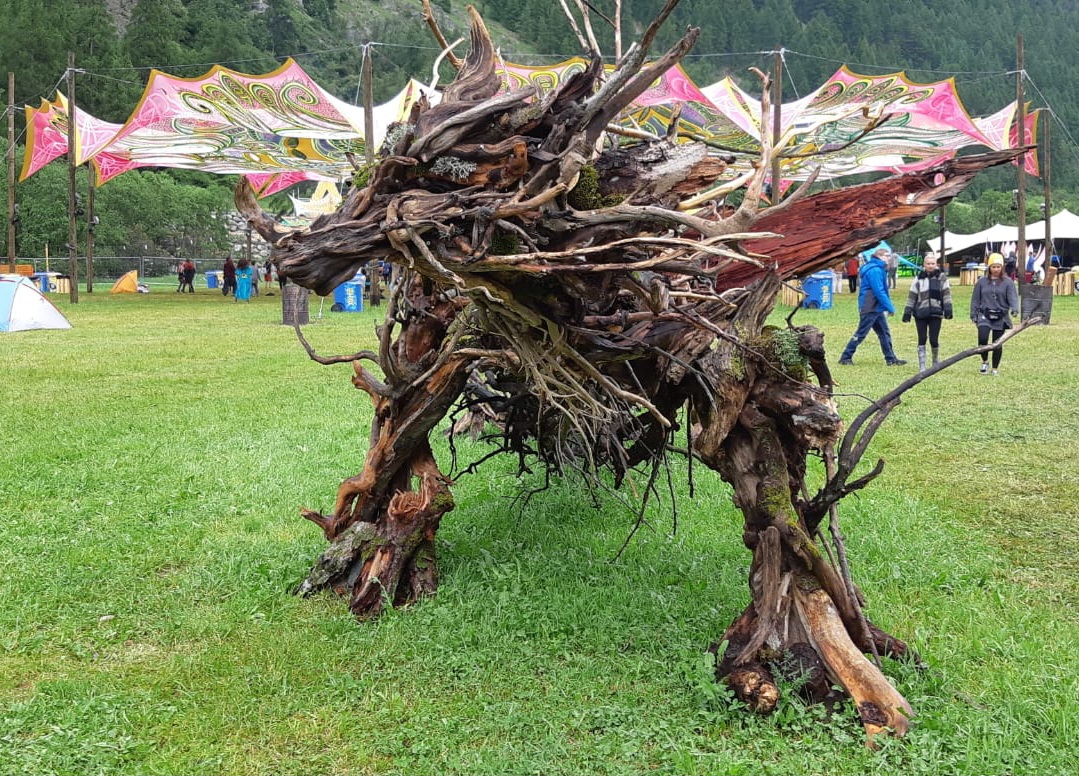
Dragons, Ciricǎ says, are important figures in Romanian folklore, which he looks forward to sharing with the other participants in Black Rock City.
“The dragon is a legend from our lands; our ancestor had a dragon shaped flag, it’s a symbol for us of courage and honor. I’m bringing the opportunity to meet a dragon,” he says happily.
It’s Impossible to Build Something Like this with Just Your Knowledge
While Ciricǎ’s dragon asks viewers to imagine together, Colombian artists and spouses Santiago Caro and Tixana Ospina’s sculpture, “ALUNA: The Frequency of Being,” asks playa participants to notice themselves in the present moment.
Their sculpture draws from intricate indigenous Tairona goldwork traditions, reframing gold from the mystical Sierra Nevada de Santa Marta region of Colombia away from the colonial idea of the limitless wealth of the El Dorado legends, and toward a spiritual connection between people, ancestors, and the natural world.
The 12-foot tall interactive sculpture, which in lieu of gold is being built from brass and stainless steel, features ever-shifting sound and a hologram screen projecting images that participants help control.
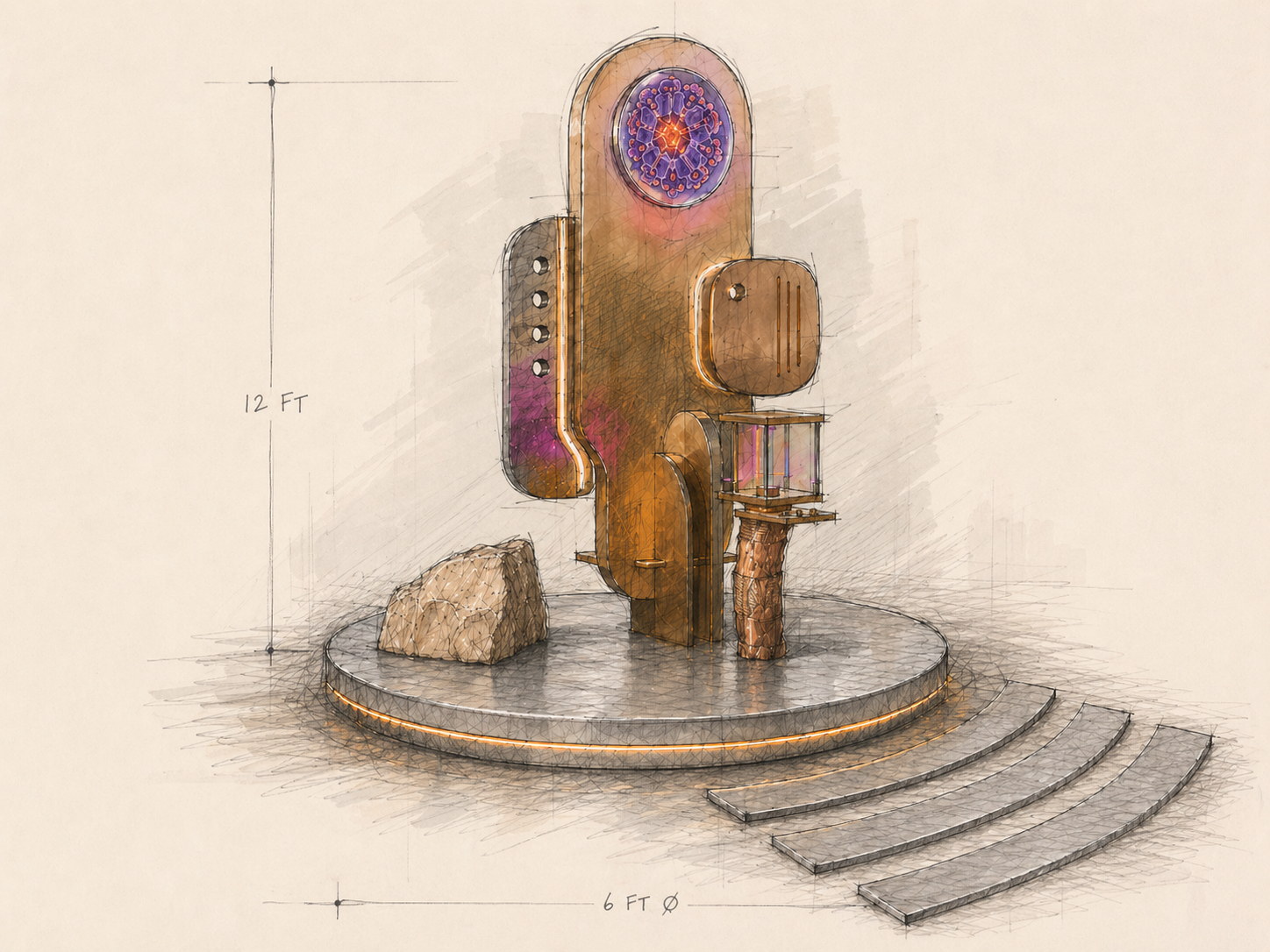
“The participants are co-creators of the artwork,” Caro says, noting that nearby voices, music, and sounds all generate ever-changing visual patterns. “There are sensors, so the closer you get the more it wakes up. When people come close to the artwork they are going to experience something unique based on how they approach it. The idea is to bring awareness.”
But beyond asking participants to be in the moment, “ALUNA” also reflects the couple’s commitment to the region.
“‘ALUNA’ is blending Colombian ancestral knowledge and technology,” Caro says. “The Sierra Nevada de Santa Marta region is very important to our ancestral cultures. It’s a spiritual place, a magical place.”
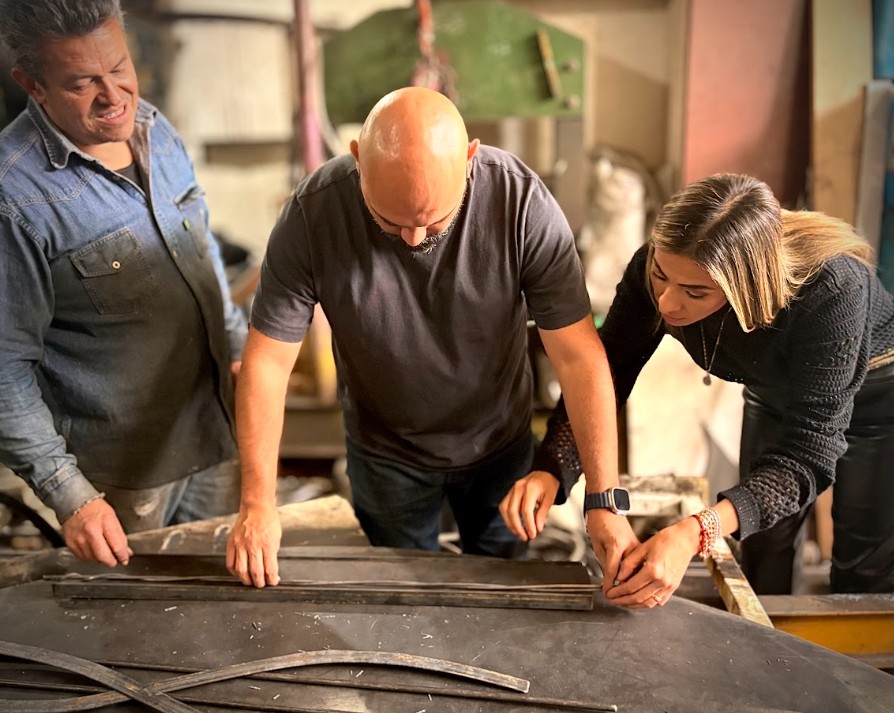
That intersection of ancestral knowledge, digital tech, and public participation mirrors the intensely collaborative process that brought the project to life. Caro and Ospina say that building this dream together as spouses adds perhaps the most important influence on the work. But in addition, their crew — which is made up of Colombians living in the United States and abroad — features a fabrication team that stretches across disciplines. Artists, engineers, programmers, and projection specialists are each contributing expertise.
Tito Caicedo is the projection expert behind “ALUNA”’s visuals. His contributions include deciding what the visuals required, designing the components, and building the tech. Born in Colombia, he now calls Colorado home,
“I built the prototype in Colorado, and everything has to be very carefully planned because things have to fit into a defined space,” he says. “Everything has to be done collaboratively. This is a very Colombian effort. The root of the project is something that is essential to Colombian culture.”
Now, the team simply needs to get the various parts from Colombia to Black Rock City.
Caro and Ospina know the demands of bringing art to Burning Man, having been three times previously. In 2023, the couple brought “YALUKA,” a gold-toned Tairona-inspired sculpture of a caiman. This year, “ALUNA” is traveling more than 4,000 miles via ship and trucks to make it to playa. Afterwards, the couple hope to be able to bring the sculpture back to Colombia.
“Logistically, it’s very complex,” Caro says of both building and transporting “ALUNA.” “But it’s all about collaborating and working together. It’s impossible to build something like this with just your knowledge.”
An Incubator for Collaboration
That, it seems, is the common theme.
Playa art is all but impossible to dream, build, and install with one set of knowhow. It takes teamwork to bring such ambitious projects to Black Rock City. So whether you find yourself drawn to “ALUNA,” standing face-to-face with a dragon, or moving in rhythm with a dozen strangers, it’s worth remembering that behind each sculpture is a community blending traditions and combining skills while solving unsolvable puzzles. And while some of the works on playa may burn or disappear back into workshops, the lessons of collaboration they fueled remain.
Cover image: “Harmonic Orbiter” by Linda Qian and the Harmonic Orbiters, 2026 (Photo by Bryce Abraham)